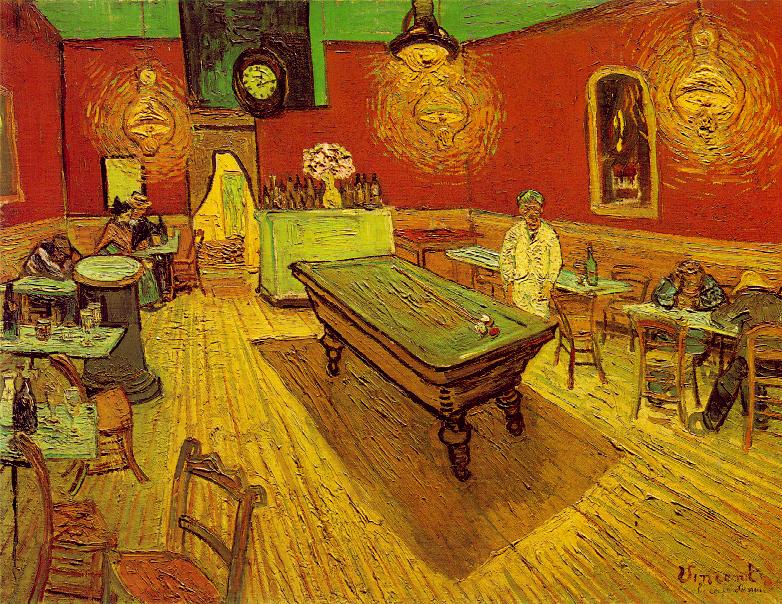
A = Van Gogh's The Night Cafe
B = a perfect forgery of Van Gogh's The Night Cafe
1) Do the aesthetic properties of A depend on anything more than its appearance? Should we take into account culture; artistic intentions, explicit claims or statements made by the artist; historical context?
2) Does anything beyond the visual appearance of A determine its aesthetic properties?
3) If A and B are visual identical, to the extent that even an expert on A and B cannot tell them apart, do A and B have identical aesthetic properties?
4) Do have answers to these questions? No, I do not.

1 comment:
If we are to assume that the "perfect forgery" is indeed perfect, we lose the ability to discern which one is the copy and which is the original completely. I am taking "perfect" to it's logical extension here for the purpose of the argument. The brush strokes, paint depth, chemical composition, aging, etc., etc. etc., must be perfect in every way. Almost as if the Van Gogh orignial and the forgery were both copies of an artistotelian form.
The artist himself would not be able to make that distinction any longer. Therefore it leaves both pieces in an aesthetic zero-sum game.
All of the non-observable factors are brought to bear on the artwork by the observer and carry equal weight with both the original and the perfect copy.
It does not make the perfect forgery the same as the original, as only Van Gogh could paint "Van Gogh's The Night Cafe", but the observer (in the sublime ignorance of being human) has no means to adhere the value of being "original" to either one.
It is a bit like the old question "which came first, the chicken or the egg?". Obvioulsly the egg came first as there were animals which are egg laying millions of years before chicken evoloved in to existence. The more specific question would be "which came first, the chicken or the chicken egg?". Also readily answered, as only a chicken can lay a chicken egg.
Post a Comment